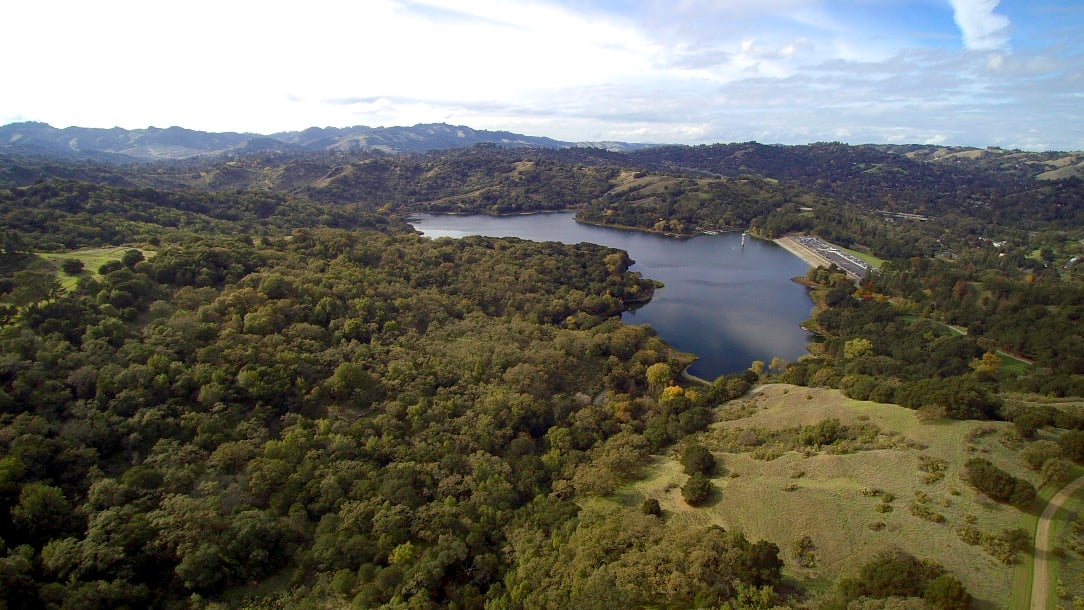
If you've walked, run, or driven past the Lafayette Reservoir this summer, you've probably noticed something odd happening to the tower. The concrete structure that rises out of the water near the dam, the one with the distinctive gazebo-like crown that's been part of every postcard shot of the Res since before your grandparents' generation, is wrapped in scaffolding and protective netting. Its windows are gone. A barge sits alongside it. If you paid close enough attention around the Fourth of July, you may have caught the top being cut away in sections and lifted off by crane.
None of this is decay. It's the opposite. After years of being the kind of project locals half-joked would never actually happen, EBMUD's seismic retrofit of the reservoir's outlet tower is underway, and it's the reason the skyline over your favorite loop looks different right now.
The short version: the tower is coming down by more than 40 feet as part of a $14 million, state-approved safety upgrade, and it's happening at the same time as a separate sewer project, which makes this the busiest construction stretch the Reservoir has seen in years. Almost none of that disruption reaches past the dam and the Lakeside Nature Trail. Fishing, hiking, picnicking, boat rentals, and the trail system remain available, though visitors may encounter delays near the work zone.
A Landmark That Outlasted Its Own Deadline
The outlet tower was built in 1929, four years before the reservoir itself was completed, and it has functioned as both infrastructure and icon ever since. It controls water release from the reservoir, which EBMUD still holds in reserve as an emergency drinking supply even though the Res itself is now a recreational lake. Its rooftop silhouette, boxy base and open-air crown, shows up in nearly every photo anyone has ever taken from the dam side of the loop.
That silhouette is what's changing. The upper portion doesn't meet modern seismic standards, and the state's Division of Safety of Dams approved a project to shorten and reinforce it so it can survive a major earthquake without failing. EBMUD had been signaling this project for a while, but it kept slipping. This year it stopped slipping.
How the Work Actually Unfolded
Bay Area Telegraph reported the project timeline from summer 2025 planning through the fall 2027 target. Here's the sequence, including later updates:
- Summer 2025: Construction planning finalized.
- Fall 2025: Site preparation begins around the tower and dam.
- February 26, 2026: EBMUD hosts a virtual community meeting to walk residents through access changes and the construction timeline.
- July 6, 2026: Physical demolition of the tower's upper section begins. Crews cut the operating house roof into two pieces and lift it off by crane barge, then saw-cut the walls into sections for removal the same way.
- Through fall 2026: This is the peak construction window, with the tower project running at the same time as EBMUD's separate Wastewater Collection System Improvements project nearby.
- Fall 2027: Target completion for the tower upgrade.
That overlap between the two projects is worth sitting with for a second. It's not one crew working one job. It's two separate EBMUD projects, seismic upgrade and sewer work, both active at the same site through the back half of 2026. EBMUD itself has described this period as the heaviest construction footprint the Reservoir will see during the entire multi-year effort.
How the Work Affects Visitors
Here's the detail that actually matters if you use the Reservoir regularly: trucks carrying tower debris exit through the Acalanes Road onramp rather than through the streets most residents drive to get to Mt. Diablo Boulevard. The demolition is visually dramatic if you're standing on the dam or the barge ramp side of the trail. It is functionally invisible if you live three streets away and just want to know whether your commute changed. It hasn't.
The same logic applies inside the park. Construction noise and crew activity are concentrated near the Lakeside Nature Trail and the barge ramp, and flaggers are stationed at the main entrance gate and along that stretch of trail to manage foot and vehicle traffic. Visitors should expect occasional delays of 10 to 15 minutes if they're walking through that section or driving in during active work. Outside that specific zone, the park runs the way it always has.
What's Different Right Now vs. What's Still Available
| At the Reservoir This Summer | Still Available or Unchanged During the Project |
|---|---|
| Tower fully wrapped in scaffolding and protective fabric | Fishing, hiking, and picnicking remain open |
| Crane barge cutting and removing the operating house roof and walls | Lakeside Nature Trail (2.7 miles paved) and Rim Trail (4.7 miles unpaved) run full length |
| Flaggers stationed at the main gate and along the Lakeside Trail | Bike, skate, and scooter hours unchanged (Tuesday and Thursday afternoons, Sunday mornings until 11 a.m.) |
| Occasional 10 to 15 minute delays near the construction zone | Leash rules unchanged: dogs welcome on a 6-foot leash, kept out of the water |
| Noise and equipment concentrated near the dam and barge ramp | Boat rentals, parking rates, and annual passes all unchanged |
If you're one of the people who treats the Res as a daily habit rather than an occasional outing, that right-hand column is the part that should set you at ease. Trout are still planted November through March, and a California fishing license plus an EBMUD Fishing Access Permit still gets you on the water. Rowboats and pedal boats still rent for a $40 deposit if you're 18 or older. Parking still runs $7 a day or a dollar per half hour, with annual passes at $140, or $90 for seniors and visitors with disabilities. The tower looks different. Almost nothing else does.
What's Still on the Calendar
The Reservoir's community life is continuing on schedule too. The Lafayette Res Run for Education, co-sponsored by the Lafayette Chamber of Commerce and the City of Lafayette, is held every October, traditionally on the third Sunday, and loops runners and walkers around that same 2.7-mile paved trail the tower project sits beside. Last year's 32nd annual race drew close to 2,200 participants and raised more than $37,000 split among local elementary, middle, and high schools. There's no indication construction changes that plan for this fall. If anything, running past a half-demolished tower on race day might be the most memorable backdrop the Res Run has had in years.
The Takeaway for Anyone Who Uses the Res
The instinct when you see scaffolding and a crane barge on a landmark you've looked at your whole life is to assume the worst: closures, detours, a summer of avoiding your favorite loop. What's actually happening at Lafayette Reservoir is closer to surgery than demolition. A very specific, very visible piece of infrastructure is being shortened and reinforced, and visitors may encounter delays near the dam and the immediate trail section beside it. Fishing, boating, and the full trail mileage remain available, while the dog policy and fee structure are unchanged. The tower will look different by the time this is finished; for visitors, the main difference will be construction near the dam.
If you're the kind of person who pays attention to details like this, a construction schedule, a trucking route that avoids downtown, a project that finally happened after years of talk, you probably already know why Lafayette holds onto people the way it does. That kind of local texture is what we spend our time tracking, whether it's what's changing at the Reservoir or what a specific property is actually worth once you look past the median. If you're curious how any of that applies to your own plans, the Paddy Kehoe Team is happy to talk it through. Schedule a free Home Strategy Session whenever you're ready.
This article is general information, not legal, tax or financial advice. Consult a qualified professional about your situation.